 |
 |
 |
Elachista fucicola
Rockweed Tuft, Tiny Wrack Bush
26 May 2025
Wickaninnish Bay, Vancouver Island, B.C., Canada
Tide: 0.1 foot low at 06:52 am PDT (measured at Tofino Tidal Station)
Weather: Mostly cloudy, wind SSE 10 to 15 km/hour, sea choppy, low westerly swell, humidity 76%, 13 ˚C.
Moon: New Moon (0 days); Next phase, New Moon, 8:02pm PDT; Previous Phase, Third Quarter, 20 May 2025 at 4:58am PDT.
and:
30 October 2025
Little Beach, Ucluelet, B.C., Canada.
Tide: 6.2 feet (measured at Ucluelet Tidal Station) at 12:35 PDT (time of interaction in-situ).
Weather: Mix of sun & cloud, wind W 10 km/hour, sea smooth, humidity 80%, 11 ˚C.
Moon: Waxing Gibbous, (61.4%, 9 days); Next Phase, Full Moon, 5 Nov 2025 at 5:19am PDT: Previous Phase, First Quarter, 29 Oct 2025 at 9:20am PDT.
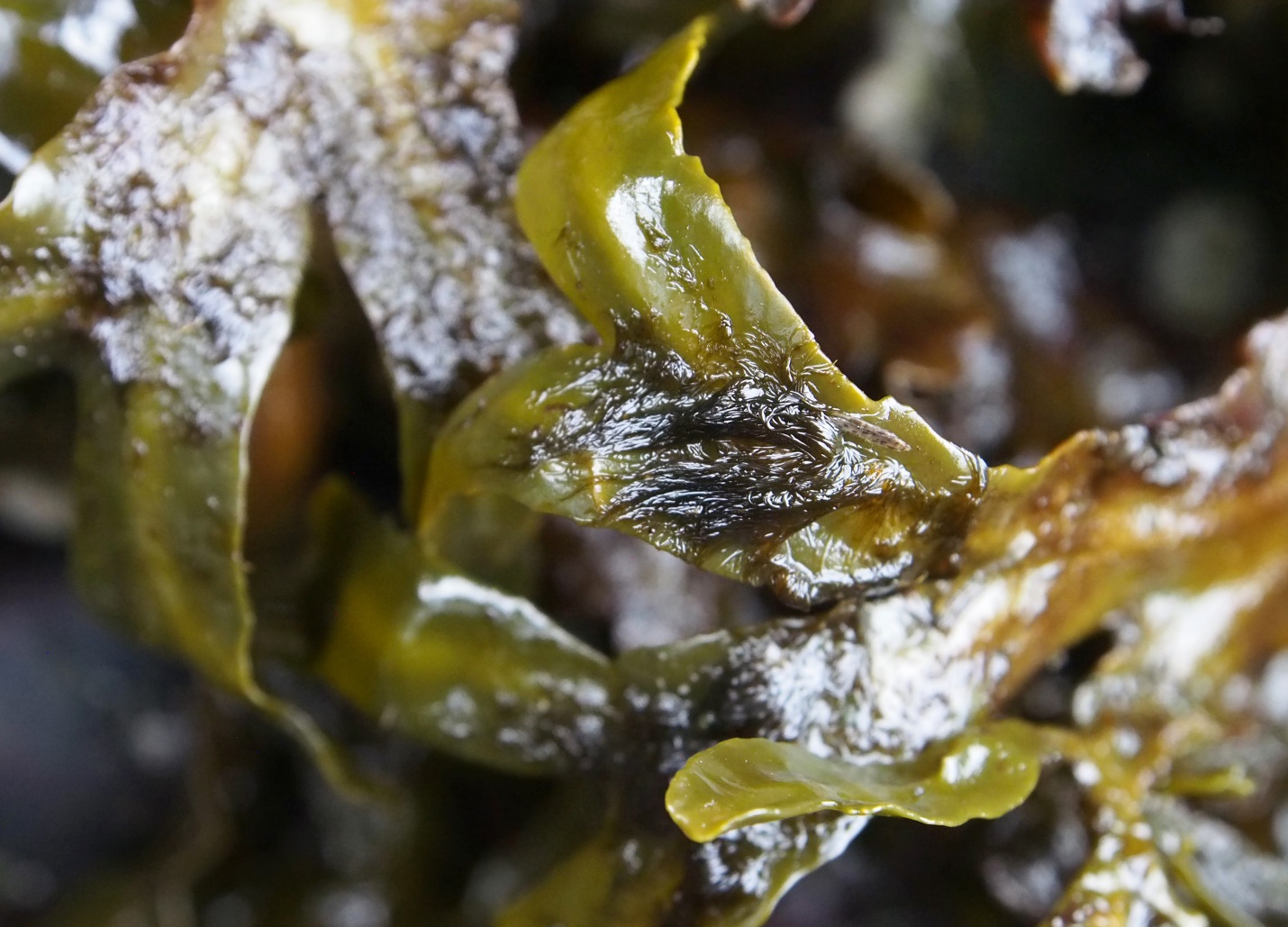
Figure 1: The delicate brown alga Elachista fucicola visible growing on the flattened thallus of Fucus distichus in this much larger than life-sized photo. The delicate filaments are short and unbranched and collapse when exposed out of water. Their preferred position is only visible when immersed. In the background other blades of Fucus are mottled with textured brown patches. These patches are more of the Rockweed Tuft. Little Beach, Ucluelet, B.C., Canada. October 30, 2025. Photo ID 27876 ©Seaweedwhisperings.com
Person 1:
(First impressions, May 2025)
Dirty.
Blends in with background, hard to detect when out of water.
Ashamed to be such a “dirty epiphyte”; not contributing much to the world.
(Deeper immersion, October 2025)
Plasters tight against the Fucus thallus when out of water. Helps reduce desiccation?
Very good at hiding. One needs to search for it. Elachista won’t willingly reveal itself.
Short delicate threads, spread tentatively in the water, not venturing far from the security of the Fucus thallus.
The delicate physical nature of Elachista contrasts with the toughness of the Fucus host.
Quickly clumps together when removed from water, almost as though cowering in fright or embarrassment.
OK with having a few friends, but might feel too exposed in a big group. Perhaps unable to blend in or fit in with a group. Wishes to NOT be seen. Feels awkward in a group. Stands in the corner to hide but that makes it obvious in a different way.
Will tend to withdraw if too much attention comes their way.
Needs lots of time alone to understand themselves.
Doesn’t trust outside advice.
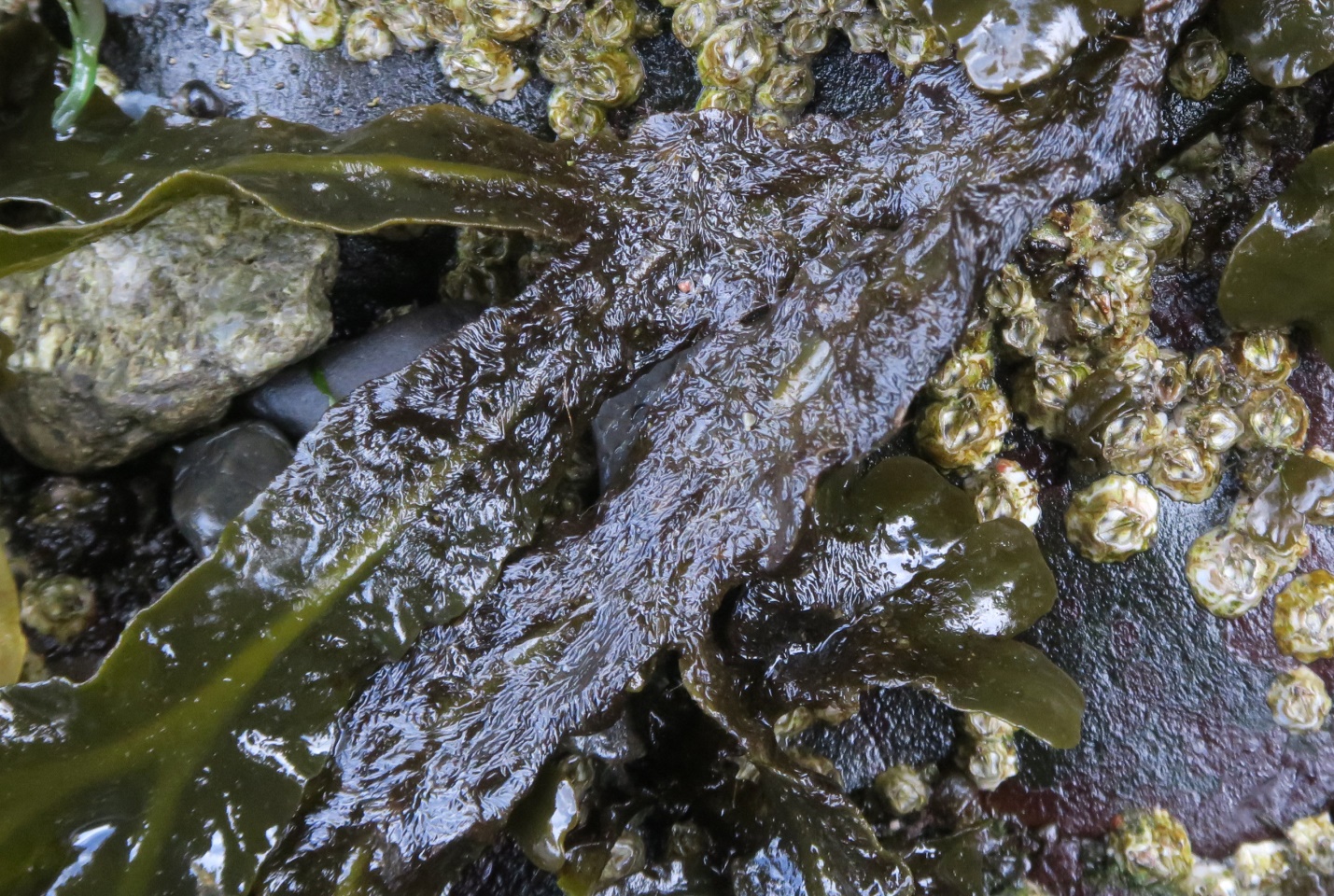
Figure 2: These blades of Fucus are hosting numerous clusters of Elachista fucicola, a perennial epiphyte that grows in our region only on Fucus distichus. The fine filaments arise from a tiny central basal cushion (rhizoidal bundles) that penetrates the host blade to anchor it in place. Some phycologists who have studied Elachista fucicola in the Atlantic (where its host is Ascophyllum nodosum) believe this relationship is more parasitic than simply epiphytic. For certain it is difficult to see any advantage for Fucus to this ‘living arrangement’ and Elachista fucicola’s energy is strongly self-centered. Little Beach, Ucluelet, B.C., Canada. October 30, 2025. Photo ID 27877 ©Seaweedwhisperings.com
Person 2:
(First impressions, May 2025)
Very fine brown filaments.
Out of water they lay limp and flat, closely aligned like silken hairs, and mainly disappear into the background.
Under water it’s a different matter – the tiny filaments spread out like an old fashioned powder puff. They are fine and delicate and spaced evenly, no clumping or tangling.
What do / did people use powder puffs for? Primarily it is with makeup; to control shine or hide sweat, to set or lock in certain concealers and foundations, to present a more matte appearance..., and while often makeup is used to enhance certain structural facial features, often it is used to minimize the visibility of blemishes on the skin or to draw the observers eye away from facial contours felt to be ill-proportioned or otherwise unsightly.
This is interesting – all these ideas of preparing to be seen by others and taking pains to have one’s make-up in place for that, because Elachista fucicola out of water is rather NOT seen, totally blended into the backdrop of its fucoid host – in such circumstances it wouldn’t matter if it had its face ready to show the world. In water, though, it is, for its size, quite visible and showy.
Is this the dichotomy felt with the Elachista energy --- on one hand fully displayed and presenting itself to the world as in the manner in which it wants to be seen, and on the other hand, hidden, flattened, limp and so drab looking it’s almost invisible?
(Deeper immersion, October 30, 2025)
Tufts of brown filaments – groupings of you populate the older portions of Fucus distichus thalli.
There is a strong population of this duet at this corner of Little Beach where bedrock meets boulders and rough gravel and sand. It’s a ‘rough and tough’ corner and the Fucus is hanging on well here. And because the Fucus has persisted, this has given opportunities to interdependent life forms. Rockweed tuft grows on Fucus. And while it is very small and does not have a big physical presence, the brown filaments definitely change the look of the Fucus individuals it is living on. The Fucus then looks older; its simple form and color are confused; it even looks somewhat blemished, dirty, unwashed, perhaps unshaven. It has the look of something not cared for, something neglected and beginning to molder and perhaps soon even rot.
But that is the Fucus host; Elachista itself is something else. Elachista fucicola is a collection of very fine brown filaments that puff out/radiate broadly when immersed. The filaments are short and unbranched, and they have a central anchor point. Several of these “tufts” often live on one Fucus blade and they can create an irregular dark brown pelt to the otherwise smooth olive green surface.
Out of water Elachista fucicola filaments look quite sleek – like the well-oiled fur of an aquatic mammal. This sleek quality, along with being unbranched, means Rockweed tuft doesn’t get tangled up in itself.
The patches of Elachista grow spaced out from each other a bit in discrete starry tufts. Underwater, each filament within a single ‘tuft’ is free to splay out, like the rays of light from the sun (earth’s rather significant star). Because they all arise from a central holdfast area, they look like miniature ‘powder puffs’ and have an equally soft texture.
Soft, downy, sleek, fine, profusion of rays – there is high sensitivity possible with this.
Elachista is keenly aware, highly sensitive to its surroundings; from its Fucus home base it meets the ocean swells, taking in all that it can use.
But it doesn’t seem that Elachista gives any consideration or has much sensitivity about how its own presence may be impacting Fucus. They are not thoughtless so much as fully engaged with their own needs. To them the Fucus is viewed as though created expressly for Elachista’s specific requirements – that’s a given.
Fucus exists for Elachista. Elachista exists for itself.
So, they can be single minded and self-serving, but I don’t sense that Elachista has any malice to their actions; they are still too inexperienced to have that kind of intent. There is also a strong dependency that exists – Elachista needs Fucus or it cannot live. It is fortunate for Elachista that Fucus distichus is such a ubiquitous and successful macro alga.
As soon as I wrote the previous sentence I found myself wondering if Elachista had perhaps tried to live as an epiphyte on other host species but none other had been satisfactory. I suspect that any evidence of failed attempts would be next to impossible to locate. I also think that Elachista would be quick to learn and almost desperate to remember who their ideal host is.
There are countless populations of Fucus distichus on our coastlines, yet you will find Elachista fucicola growing only on a few of them. It seems this little epiphyte is even more specific in its needs – it wants to live on Fucus, yes, but also in wave-swept environments. Then it seems they feel their needs will be well met.
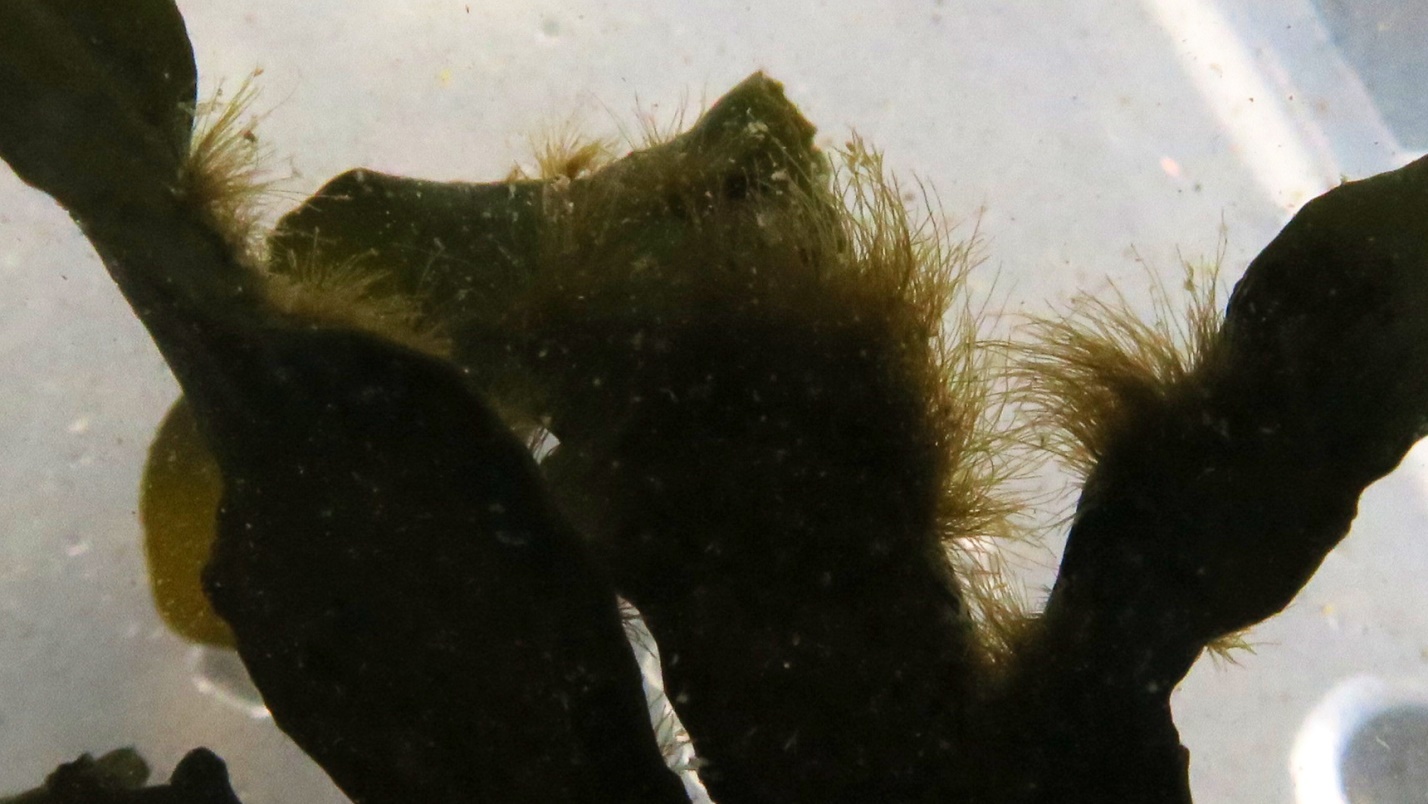
Figure 3: Backlit in a bowl of sea water with the Fucus blades appearing only as silhouettes, several puffy clusters of brown filaments of Elachista fucicola are visible as they prefer to be – immersed in water and radiating out in all directions. Little Beach, Ucluelet, B.C., Canada. October 30, 2025. Photo ID 27878 ©Seaweedwhisperings.com
Discussion:
Sensitivity – this is why they collapse so quickly and thoroughly when conditions are not just to their liking. This seems to be an immature behaviour; something one would attribute to a pampered child or a coddled self-indulgent adult.
Existing for themselves – Person 1 noted that there can be shame to their lack of contribution. But maybe the ‘powder puff’ applies a little bit of powder and the shame or embarrassment can be covered up for a while? They don’t dive too deeply into shame and it is something they’ve yet to own.
They can be very single-minded and self-serving and with that also highly unaware. Their own needs are quite specific and they will seek to have them met – irregardless of, or perhaps ignorant of, the consequences and possible costs to others.
Elachista can enjoy investigating life and will sometimes immerse themselves in amazement and maybe even become a bit unrealistic in this, get a bit carried away by it you could say. One could almost think of the fine hairs radiating as if some static electric charge was separating them. Is there some friction between the tiny filaments that comprise the group? Are they so sensitive that they easily can be upset and somewhat dramatically emotional? It feels like this is true, but the phrase “tempest in a teacup” comes to mind for this energy. The focus of their emotion is often inconsequential beyond their immediate personal desires.
‘Starry tufts’ of filaments – this phrase combined with the idea of feeling the need to wear make-up and having high sensitivity and dramatic responses could make one think of the situation of a famous public figure. A movie ‘star’, a news show host, a princess or other famous person who works in the spotlight much of the time. Possibly the similarity is that with these kinds of persons few people truly know them, they are only known for their public image which is carefully crafted and maintained.
There are relatively few public figures or movie stars in the world. For most people the energy this seaweed embodies relates to having found what one wants to portray and present to the world about one’s self – there is a kind of certainty this gives and it helps to cover up the fact that underneath it all there is often quite a lot of uncertainty to them. There is the expression to “have your game face on” which fits the idea here – it gives one confidence. Wearing makeup, putting on your game face, or something similar – it can become a need rather than a preference as there will be inner aspects that are held strongly as not to be seen by the rest of the world.
Certainly the feeling with this seaweed is that they know their home base and from there they meet the world. While doing so they can become quite excited and carried away with the moment. Other times they seem easily miffed; their highly specific tastes sometimes have them coming across as childish and petulant.
Wearing makeup to enhance one’s beauty or emphasize or minimize certain physical looks can be a tricky thing. In a way it is how one can be ‘not seen’ for who they truly are – it creates an image that is to some degree falsified. This is certainly limiting and can sometimes become a burden – to present this ‘image’ every time one expects to be seen by others. Is this partly what their withdrawal/collapse/retreat is for? To relax from the need to present themselves officially.
The energy of this seaweed is one that can be quite ‘fun’ to be around – particularly if the conditions are just right. They have much to learn yet, however, and don’t like things to be too rough as they amass some life experience. It seems that if they can get some time away from being concerned about how they look to others or what others might think about them, well, then they will have a chance to gain experience and develop a bit more genuine confidence.
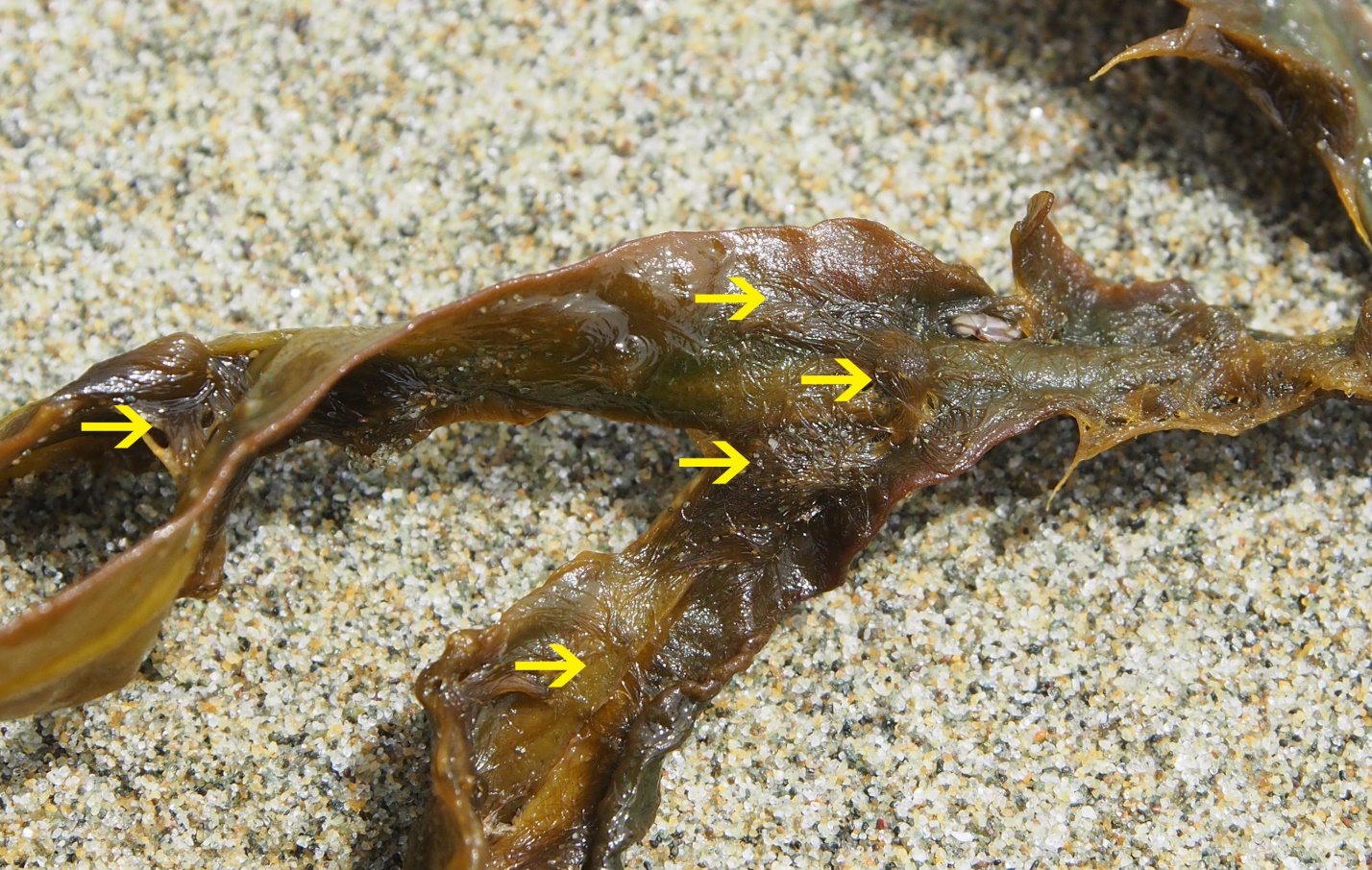
Figure 4: A cast ashore section of Fucus distichus is shown here on the sand beach at Wickaninnish. The yellow arrows direct your eye to the fine filaments growing on the Fucus. Elachista fucicola loves wave swept shores and this piece of Fucus was likely living on Sea Lion Rocks – a location just offshore that is fully exposed to the open Pacific swells and storms. Wickaninnish Bay, Vancouver Island, B.C., Canada. May 26, 2025. Photo ID 27879 ©Seaweedwhisperings.com
Biology & Natural History Information:
Description:
This is a perennial tufted brown alga that is epiphytic on specific fucoid hosts. Thalli arise from bases composed of densely packed rhizoidal bundles to form hemispherical cushions of erect, free, straight and unbranched filaments. Individual filaments grow from 0.7 to 2 cm high and dense tufts may grow to 1.5 cm in diameter.
Habitat:
Elachista fucicola grows epiphytically on Fucus spp. and in our region prefers wave swept populations of Fucus distichus on which to make its home.
North Pacific Distribution:
Southern Alaska to Humboldt County northern California.
Remarks:
Phycologists doing work with this species are suggesting that Elachista fucicola will be found to be distributed in the Arctic and the Atlantic only, and that what has been currently thought of as E. fucicola in British Columbia (and presumably most of the Pacific records) belong to a separate genetic group. Further taxonomic study is needed but until that occurs we are working with the current scientific name of E. fucicola.
Deckert and Garabary (2005b) in their Atlantic based studies concluded that Elachista fucicola acts as a parasite and causes tissue deformation when its rhizoidal bundles penetrate the host species, Ascophyllum nodosum. They reported that in response the host’s surface cells proliferate to form a donut-shaped ring adjacent to the invading rhizoids; a pit forms and host cells next to the infection chamber form an epidermal layer.
Classification:
Empire: Eukaryota
Kingdom: Chromista
Phylum: Heterokontophyta
Subphylum: Ochrophytina
Class: Phaeophyceae
Subclass: Fucophycidae
Order: Ectocarpales
Family: Chordariaceae
Genus: Elachista
Species: Elachista fucicola (Velley) Areschoug 1842
Former Name(s):
Homotypic synonym; Conferva fucicola Velley 1795.
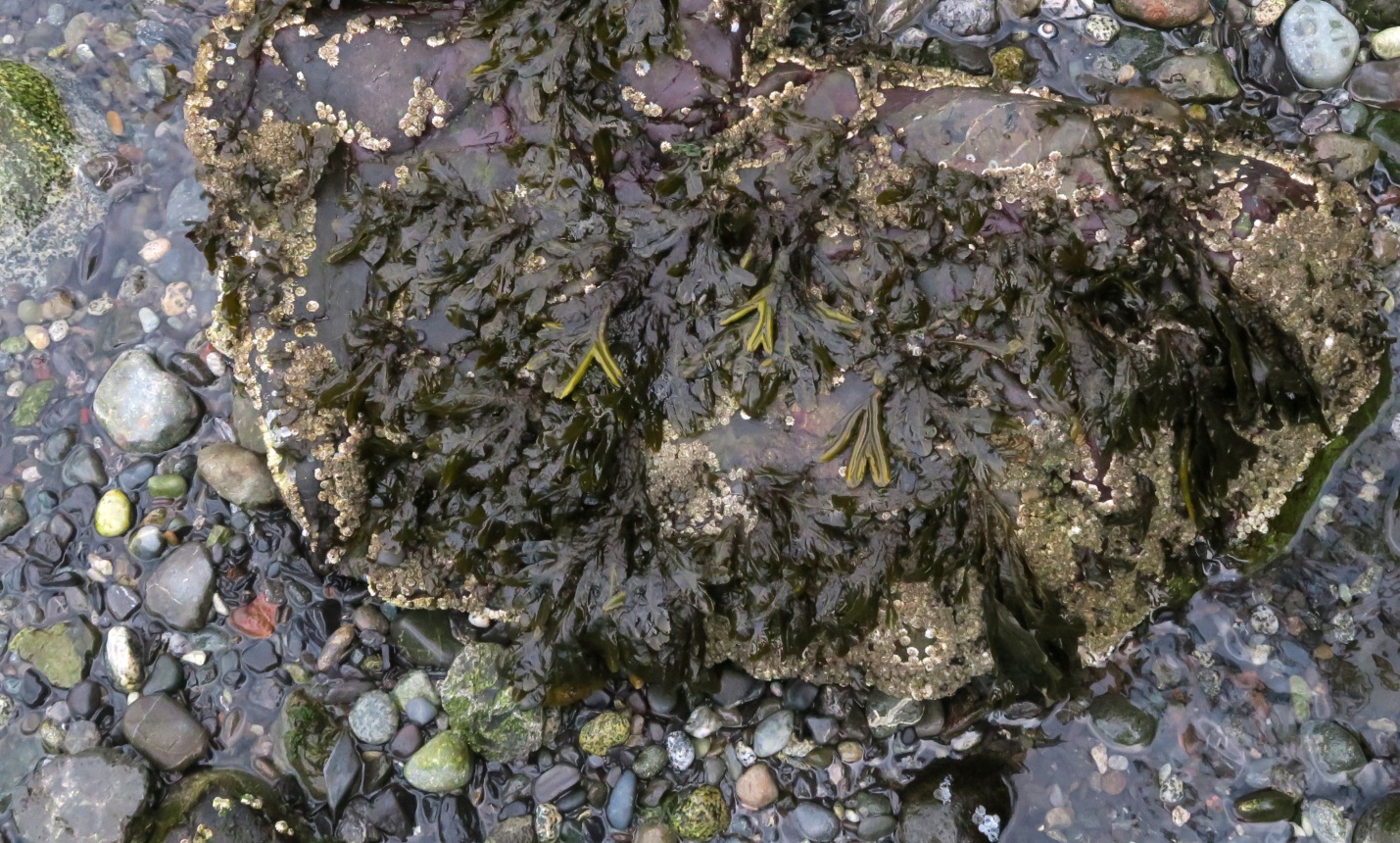
Figure 5: This medium sized rock is home to many acorn barnacles and a strong showing of Fucus distichus. Most of the forked olive green with strong midrib blades of the Fucus here are obscured by a brownish coating – this is Elachista fucicola. When Elachista is this abundant it really does ‘blemish’ the look of Fucus. Little Beach, Ucluelet, B.C., Canada. October 30, 2025. Photo ID 27880 ©Seaweedwhisperings.com
